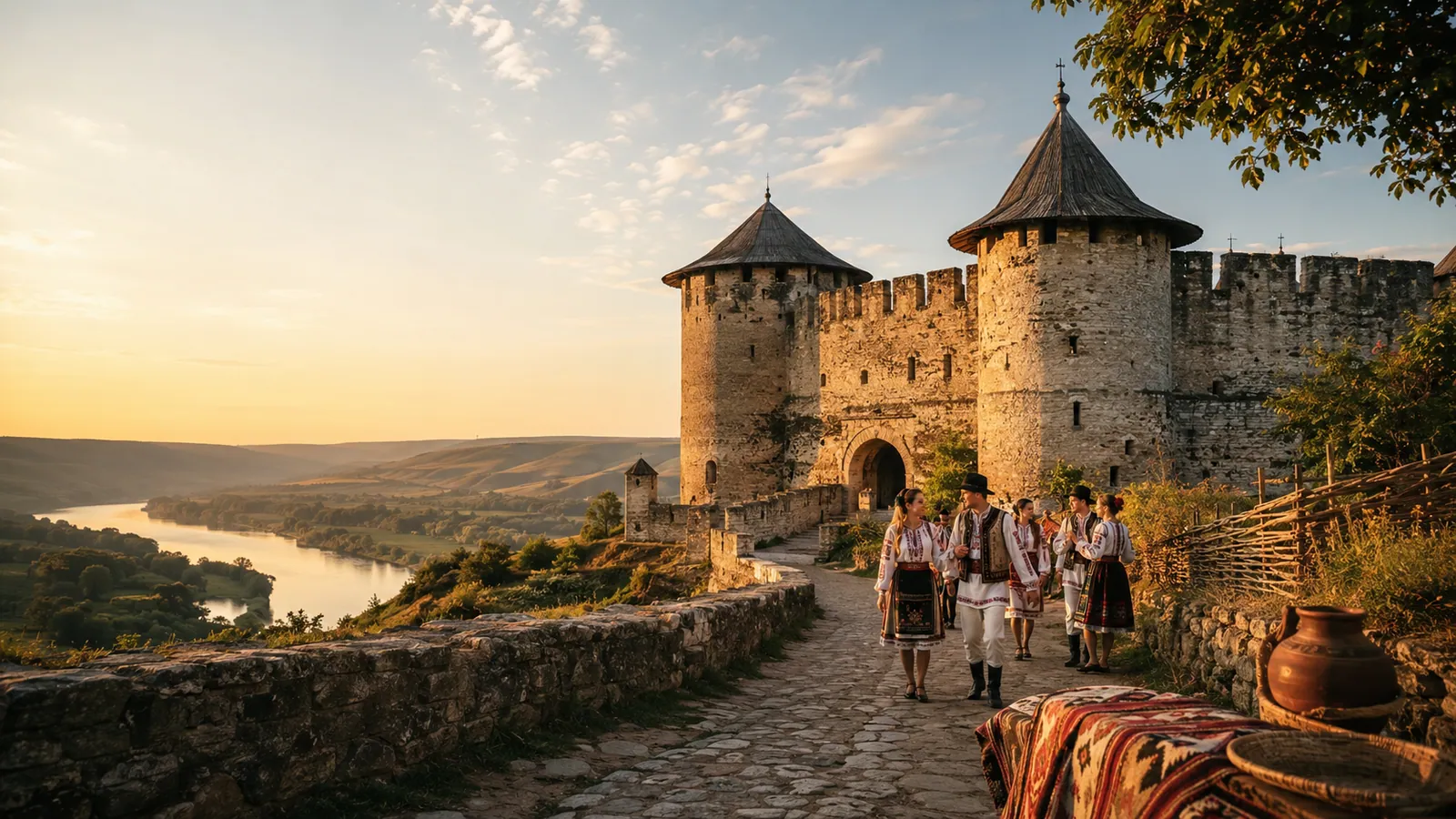
A medieval fortress in Moldova

The history of Moldova

Six centuries in a few minutes of reading: the principality of Ștefan cel Mare, the Russian annexation, the union with Romania, the Soviet period and the road since 1991.

Medieval Moldavia

sec. XIV – XVIII

The Principality of Moldavia was one of the most powerful principalities in medieval South-Eastern Europe. Founded in 1359, medieval Moldavia stretched from the Carpathians to the Black Sea, with its capital at Suceava.

Its most important voivode was Ștefan cel Mare (1457-1504), who ruled Moldavia for 47 years and won remarkable military victories. Under his reign, Moldavia built spectacular monasteries, today part of the UNESCO heritage.

The cultural identity of medieval Moldavia — the Romanian language, the Orthodox faith, the traditions — still forms the basis of the identity of the Republic of Moldova today.

1359Întemeierea Țării Moldovei1457Ștefan cel Mare urcă pe tron1504Moartea lui Ștefan cel Mare
Bessarabia

1812 – 1918

In 1812, the Russian Empire annexed the eastern part of the Principality of Moldavia, between the Prut and the Dniester, naming it Bessarabia. It remained part of the Russian Empire for over a century.

The period brought the Russification of the administration and of education, demographic changes and cultural influences that are still felt today. Even so, the Romanian population preserved its language, its traditions and its identity.

1812Anexarea Basarabiei de către Imperiul Rus

The union with Romania

1918

On 27 March 1918, Sfatul Țării (the Country's Council) — the parliament of the Moldavian Democratic Republic — voted for the union of Bessarabia with Romania.

The moment took place against the background of the collapse of the Russian Empire and of the national movements across Europe. The union marked Bessarabia's return to the Romanian space, after more than a century of Russian administration.

1918Unirea Basarabiei cu România (27 martie)

The Soviet period

1940 – 1991

In 1940, following the Ribbentrop-Molotov Pact, the Soviet Union annexed Bessarabia, creating the Moldavian Soviet Socialist Republic (MSSR).

The period brought industrialisation and urbanisation, but also repression, deportations and a systematic policy of Russification. Soviet infrastructure is still visible in Chișinău and in other cities.

1940Crearea RSS Moldovenești1989Limba română redevine limbă de stat

Independence

1991

On 27 August 1991, the Republic of Moldova declared its independence from the Soviet Union, becoming a sovereign state.

The first years were marked by the conflict in Transnistria (1992), political instability and economic difficulties. Gradually, Moldova built democratic institutions and began the process of European integration.

1991Declararea independenței (27 august)1992Conflictul din Transnistria

Moldova today

prezent

Moldova today is a country in transformation. Chișinău is becoming increasingly cosmopolitan, Moldovan wine is going through a spectacular revival, and tourism grows from year to year.

Moldova signed the Association Agreement with the EU in 2014 and received candidate country status in 2022. The younger generations combine a traditional identity with European aspirations.

2014Acordul de Asociere cu Uniunea Europeană2022Statut de țară candidată la UE

Note: On sensitive subjects such as Transnistria, relations with Russia or European integration, information can change quickly. Always check official sources and recent updates.

Frequently asked questions

Questions about the history of Moldova

Who was Ștefan cel Mare?

The most important ruling prince of medieval Moldavia, who led the country for 47 years (1457–1504), won military victories against the Ottomans and founded numerous monasteries and churches.

What does Bessarabia mean?

The name given by the Russian Empire to the territory between the Prut and the Dniester, annexed in 1812 and left under Russian administration for more than a century.

When did Moldova declare its independence?

On 27 August 1991 the Republic of Moldova declared its independence from the Soviet Union, becoming a sovereign state.

What was the union of 1918?

On 27 March 1918, Sfatul Țării (the Country’s Council) voted for the union of Bessarabia with Romania, amid the collapse of the Russian Empire and the national movements across Europe.

What is Moldova’s relationship with the European Union?

Moldova signed the Association Agreement with the EU in 2014 and received official candidate-country status in 2022.

Places to stay near the historic sites

Compare guesthouses and hotels on the map, close to the fortresses and monasteries.

Map provided by Stay22. Bookings are completed on the partner platforms.

See the history on the ground

Visit fortresses, monasteries and historic places on a guided tour.

From the same family

Travel guides for the whole region